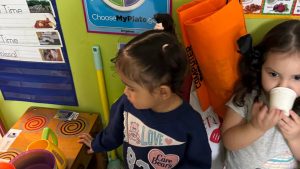



A quick look around the lobby can tell you a lot. But it can’t show you every conversation, caring response, and thoughtful learning moment happening in a classroom.
That’s where a Texas Rising Star assessment comes in.
If you’re searching for a texas rising star daycare houston families can feel good about, you may be wondering what the rating actually means. In plain language, it’s a closer look at the quality behind the scenes, not just whether a classroom looks attractive, but how children are supported throughout the day.
At Computer Kids Daycare, we’re proud of our 3-Star status through Texas Rising Star. Here’s what an assessor looks for, what that means for your child, and why this work matters to you!
The assessment looks beyond the lobby!
Texas Rising Star organizes its assessment around four areas:
- Director and staff qualifications and training
- Teacher-child interactions
- Program administration
- Indoor and outdoor learning environments
Together, these areas help paint a broader picture of a childcare program. The assessment considers the people supporting children, the way teachers interact with them, how the program is managed, and the spaces where children learn and play.
Some requirements are structural: a program must meet all required measures before it can receive a star level. Other measures are points-based and contribute to the program’s overall score.
That means a tidy room or a cheerful welcome matters, but neither one tells the whole story. Quality is built through the environment, the program’s practices, and the everyday experiences children have with the adults around them.
The most important part happens between teachers and children!
Here’s a detail many parents don’t know: Teacher-Child Interactions carry 40 percent of the overall score. More weight than any other assessment category.
Why put so much emphasis on interactions? Because children’s experiences are shaped by the care and guidance they receive throughout the day. A teacher’s warm response, encouraging question, or calm support can help a child feel secure enough to participate, communicate, and try something new.
During an observation, assessors look at several aspects of those interactions, including:
- Group sizes and staff-child ratios in center-based care
- Warmth and responsiveness
- Support for children’s language
- Play-based interactions and guidance
- Help with self-regulation
- Instructional approaches that support learning
This isn’t about expecting children to sit perfectly still or perform for a visitor. Children are children! The focus is on how the adults guide and support them during real classroom experiences.
A classroom observation is a closer look at real moments!
An assessor doesn’t stand at the door for five minutes and call it done. A classroom observation is a long, quiet sit-in: enough time to see greetings, a transition, a group activity, free play, and the small moments in between. That duration matters, because a single snapshot can’t show how a teacher responds when a child is frustrated, or how a room feels when the activity changes.
They may see children talking, playing, moving between activities, exploring materials, or working through a big feeling. They’re looking at how teachers engage with children across those ordinary moments, not just at a polished display or a special activity.
What might support a child’s learning during play? A teacher might listen to a child’s idea, respond with language that builds on it, or offer a gentle prompt that helps the child keep exploring. When children feel frustrated, the way an adult responds can help them begin to manage those feelings and rejoin the group.
Those small interactions may be easy to miss from the lobby. But they’re a big part of what makes a classroom feel safe, welcoming, and ready for learning!
The rating reflects a program, not one perfect morning!
An assessment morning can sound like a high-pressure event. But the goal isn’t to make a classroom look perfect for a visitor. It’s to evaluate a program against Texas Rising Star’s requirements and points-based measures.
The four categories don’t all carry equal weight. Teacher-child interactions count for 40 percent, while each of the other three categories counts for 20 percent. A program must also meet the required structural measures before a star level can be awarded.
For the points-based measures, a Three-Star rating falls in the 1.80 to 2.39 average-score band. That score sits within a framework that considers multiple measures, not just one activity, one conversation, or one classroom detail.
So what does our 3-Star status mean for you? It’s a meaningful quality marker that reflects assessment across the program’s required and points-based measures. It’s not a promise that every moment will be flawless. It’s evidence that the program has met the required measures and been evaluated against Texas Rising Star’s quality standards.
What you can look for during a tour!
You don’t need to memorize a scoring guide to ask thoughtful questions. When you visit a daycare Houston TX families are considering, look beyond the first impression and ask what everyday care feels like for children.
Here are a few helpful questions:
- How do teachers comfort children who are upset or having a hard time?
- How do children get opportunities to talk, play, explore, and make choices?
- How do teachers support children as they learn to share, take turns, and manage feelings?
- What does the classroom environment make possible for children?
- How does the program share information with families?
Notice the feeling in the room, too. Do children seem engaged? Are teachers paying attention and responding to them? Does the space invite children to explore? Those observations can help you picture your child’s day.
And remember: a short tour is only one glimpse. Ask follow-up questions, share what matters most to your family, and take the time you need to feel comfortable.
Quality is built into everyday care!
At Computer Kids, we believe early learning should include caring relationships, meaningful play, and experiences that help children grow in confidence. Quality isn’t a special event. It’s part of how we support children day after day.
That foundation matters for early childhood education Houston families are looking for, whether your child is an infant, a toddler, or getting ready for kindergarten. We offer programs for children from infancy through age 12, with options that include infant care, toddler programs, preschool, government-funded Pre-K, and after-school care.
Our Belle Park location is also recognized as a Center of Excellence through Collaborative for Children. That’s another quality marker we’re proud to share with families.
Want to learn more about our classrooms and programs? Explore our programs, learn about our preschool program, or read more about our accreditation.
Choose care with confidence!
Texas Rising Star helps bring attention to the things families may not see at first glance: the quality of teacher-child interactions, the way learning environments are considered, and the requirements programs must meet before receiving a star level.
That’s the stuff beyond the lobby, and it matters!
We’d love to help you see the difference for yourself. Schedule a visit, ask your questions, and get to know the Computer Kids family. Your child deserves a warm place to learn, play, and grow, and we’re here to help you find the right fit!